How a reading is made.
Updated November 2026
1. The direction of your front door
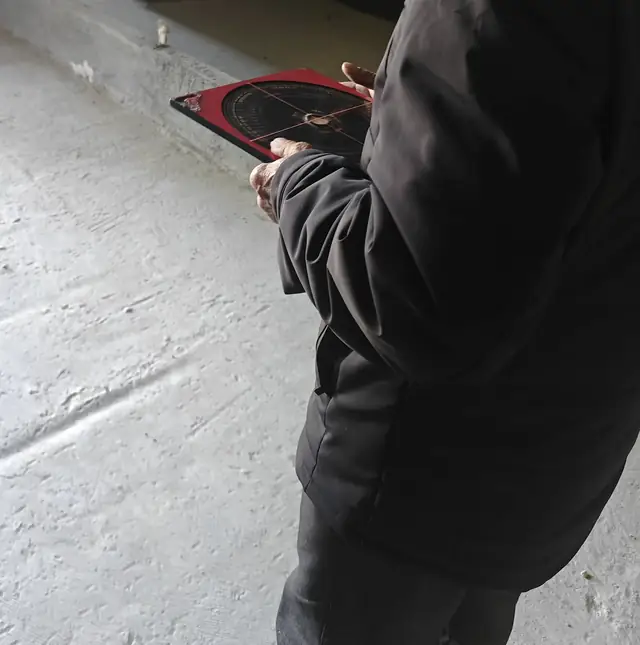
Everything starts with one number: the compass bearing you face when you stand inside your home looking out through the open front door. Between 337.5° and 22.5° is North, 22.5° to 67.5° is Northeast, and so on around the eight directions. We ask you to measure it with your phone; if you can’t, we work it out from your address and tell you how confident we are.
2. The bagua, laid over your plan
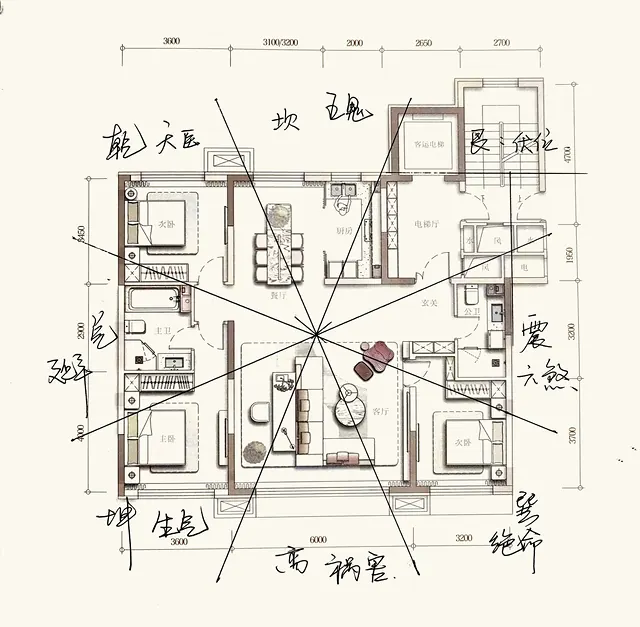
We divide your floor plan into nine equal parts and match each to a compass direction. In the Later Heaven arrangement each direction carries a trigram, one of the five elements and an area of life: North is Water and career, Northeast is Earth and knowledge, East is Wood and family, Southeast is Wood and wealth, South is Fire and fame, Southwest is Earth and love, West is Metal and creativity, Northwest is Metal and helpful people, and the center is Earth and health.
This is the compass school, the same map you see in our videos. Another well-known approach aligns the map to the front door instead of the compass. Both are living traditions and they can give different answers for the same home, so every report says plainly which one it follows.
3. The form school: what stands where
On top of the map we apply the oldest layer of feng shui — placement. Where the bed, desk, stove and sofa stand in relation to doors, windows and walls; whether you can see the door from where you sleep and work (the command position); what the front door looks straight at; where chi is said to rush and where it is said to stall. Where the map and a placement rule point different ways, placement comes first, because it describes what you live with every day.
4. The five elements
Wood, Fire, Earth, Metal and Water feed and check one another in a fixed cycle. We use them to read clashes — a sink beside a stove is Water against Fire — and to suggest colors and materials for each area of your home. For renters this is all accents: a runner, a cushion, a plant.
5. Optional: personal directions
If you give birth dates, we add a page worked out with the Eight Mansions method: each person’s kua number and the four directions traditionally said to suit them, applied to where they sleep and work in this home. The year turns at the start of spring in early February, not on 1 January; dates on the boundary are checked by hand. It is a refinement and never overrides a clear matter of placement.
What we don’t do
- We don’t calculate Flying Star charts in this reading. That school needs your building’s construction date and changes year by year.
- We don’t sell cures, crystals or objects, and nothing in a report has to be bought from us.
- We don’t promise outcomes. A report says what the tradition holds — is said to, traditionally, might — and names the principle so you can check it.
What we ask you for
- A floor plan. A hand sketch photographed on your phone is fine. Mark the doors and windows.
- Photos of each room. Two or three per room, taken from the doorway. Mess is fine — it helps.
- Which way your front door faces. A compass reading from your phone. We show you how; or just give the address.
- What you want to change. The one to three things that matter most — sleep, money, arguments, focus.
- Who lives there. How many people, who sleeps and works where, any pets.
- What can’t move. Renting, a bed that only fits one way, a fixed stove. We write inside your limits.
- Birth dates (optional). Only if you’d like the page of personal directions.
What you receive
- Your chi map. The bagua laid over your own floor plan by compass direction, so you can see which room holds which area of life.
- The top five, in order. The changes that matter most, ranked, with the time and rough cost of each.
- Room by room. Every finding numbered on your plan: what we see, the principle behind it, and what to change.
- A plan B for every finding. If it can’t move, or you rent, there’s a second-best fix written for exactly that.
- Elements and color. A palette of colors and materials for each area of your home, drawn from the five elements.
- A 30-day plan. The order to do it in, and a short shopping list. Nothing branded, nothing you have to buy from us.
Readings are written by The Chi Map studio, working with a team of Taoist practitioners from Laojuntai in Luyi, Henan — about them. The sample report shows a complete one.
The three steps
- 1. Choose your reading. Pick the size of your home and pay securely. You’re covered by a full refund until the report is sent.
- 2. Send us your home. About ten minutes on your phone: a floor plan, a few photos, your front door’s direction and what you want to change.
- 3. Receive your report. Within 5 business days, a PDF written for your rooms arrives by email. Then one round of questions is on us.
For inspiration and entertainment only. Not medical, financial or construction advice.